Background and Goals:
People who smoke and who are partnered with other smokers represent an estimated two-thirds of U.S. smokers. These dual-smoker couples face unique obstacles to quitting, are less likely to try to quit, and are more likely to relapse during a quit attempt.
Joint quit attempts could be promising for quitting but are uncommon. One way to promote join quit attempts is through financial incentive treatments, where participants are offered monetary incentive for quitting.
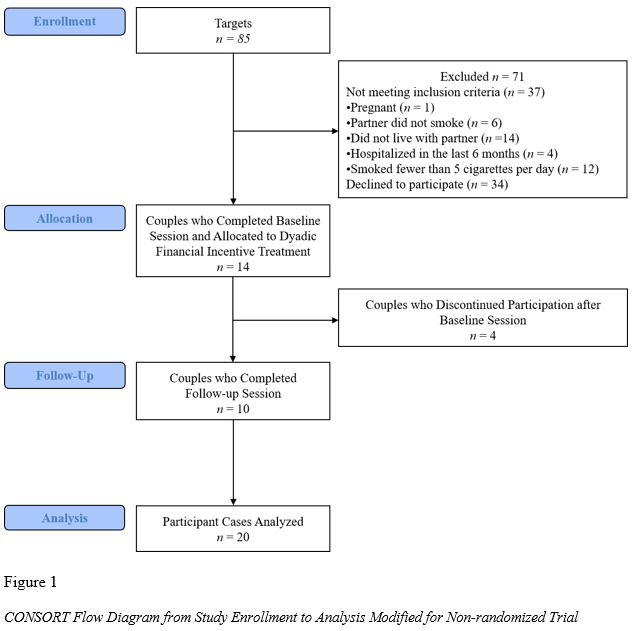
We tested the feasibility and tolerability of adapting a financial incentive treatment to a dyadic context with a sample of 14 dual-smoker couples where both members were offered incentives for attendance in a smoking cessation program and abstinence at follow-up.
This study tested the feasibility, tolerability, and potential advantages of implementing a dyadic financial incentive treatment for smoking cessation for dual-smoker couples in the U.S. over 2 months.
Method:
- Participants were screened and recruited through flyers and social media advertisements.
- Prospective participants completed an online survey to determine eligibility (i.e., 18+ years old, smoked 5+ cigarettes daily and 100+ lifetime cigarettes, in a cohabiting romantic relationship of 6+ months with another adult smoker; excluded for serious illness).
- If determined eligible, their romantic partner was emailed to conduct eligibility screening.
- Couples attended the study baseline at the lab and individually completed questionnaires about their smoking history, motivation to quit, romantic relationship quality, partner support for quitting, efficacy about quitting, and demographic information.
- The research team measured participants’ expired breath carbon monoxide (CO) in parts per million (ppm) using a piCO+ Smokerlyzer (Bedfont Scientific Ltd).
- All couples were told about the dyadic Financial Incentive Treatment
- $100 for attending all four sessions (or $75 for three of four sessions; one session per week for 4 weeks between baseline and follow-up) of the free smoking cessation program (Beat the Pack; Pfizer, Inc) offered by the research team, with the option to receive free nicotine replacement therapy with guidance from pharmacy professionals
- $100 for abstinence at follow-up, as determined by a report of zero cigarettes smoked during the previous 7 days and biochemical verification via expired breath CO (<5 ppm).
- Short survey about motivations for self/partner to quit smoking
- Follow up session one month after optional smoking cessation program, completed all measures again and smoking cue exposure, joint quit attempts, and study tolerability
Key Findings:
- Ten Dual Smoker Couples (71.4%) completed the follow-up session.
- Seven participants had biochemically verified abstinence at the follow-up session; of these, six of the seven (86%) were members of Dual Smoker Couples in which both partners were abstinent.
- Among participants who completed the follow-up session, cravings to smoke and tobacco withdrawal symptom severity were reduced over the study period.
- Participants rated the study as highly tolerable and listed many benefits and few costs from participation.
Impact:
- This project contributed to evidence suggesting that financial incentive treatments are a feasible option for smoking cessation in dual-smoker couples
- As a direct result of this project, we conducted a full-scale test of FIT treatment on dual-smoker couples across 95 couples (paper in prep)
Personal takeaways:
- Communicating properly with participants is important, especially if the study procedure/incentive structure is complex
- Many factors contribute to recruitment and retention of participants; removing obstacles when possible may help people participate more consistently
 William Schiavone, PhD